
Is Crypto Safer than A Bank?
🏦 Bank’s Fractional Reserve Lending vs. Stablecoins: Why 100% Reserves Mean a Safer Future 🛡️
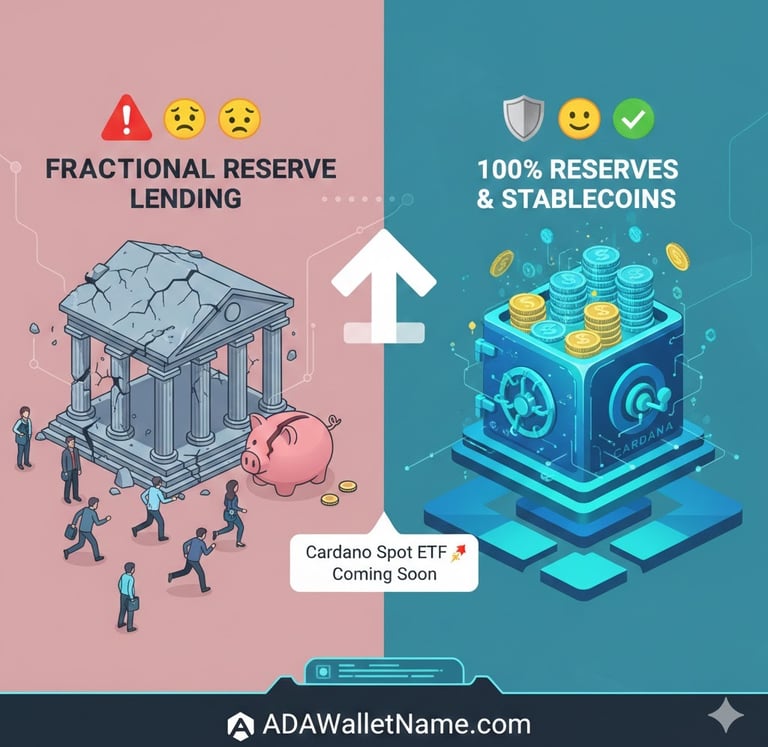
In the traditional financial world, your "money in the bank" isn't actually in the bank. Through a system known as fractional reserve lending, commercial banks only hold a small fraction of their depositors' cash, lending out the rest to create credit. While this fuels the economy, it creates a structural vulnerability: the "bank run."
If every depositor showed up at once, the bank would collapse.
Contrast this with the evolving world of Cardano stablecoins. Unlike traditional banks, leading Cardano-native assets like USDM, USDA, and DJED are built on a philosophy of 100% (or greater) reserves. On the Cardano blockchain, transparency isn't a promise—it’s a protocol.
📉 The Fractional Reserve Risk: Why Banks Are Fragile
Fractional reserve banking is essentially a confidence game. Banks take $1,000 of your deposits, keep perhaps $100, and lend out $900. If the borrowers default or if too many people want their $1,000 back simultaneously, the system requires a "bailout" or it fails.
This fragility is exactly what decentralized finance (DeFi) on Cardano aims to solve. By requiring 100% reserves, stablecoins ensure that for every digital dollar issued, a real dollar (or equivalent high-quality liquid asset) exists in a verifiable vault or smart contract. There is no "chance of a run" because the liquidity is always present.
🚀 Advances in the Cardano Stablecoin Market
2026 has been a transformative year for Cardano's liquidity. The ecosystem has moved beyond experimental tokens into institutional-grade assets:
USDM (Mehen): A fiat-backed stablecoin that provides 1:1 transparency. It is integrated directly into the Cardano ledger, allowing for instant, low-cost settlement without the friction of traditional wire transfers.
USDA (Anzens): Launched with significant liquidity, USDA has become a cornerstone for Cardano DeFi. With $0 minting fees and licensed off-ramps in over 40 countries, it bridges the gap between traditional fiat and the ADA ecosystem.
DJED: As an over-collateralized algorithmic stablecoin, DJED remains a favorite for those seeking decentralized stability. Its unique "Reserve Coin" (SHEN) mechanism ensures that even during market volatility, the peg remains backed by 400-800% in assets.
By hosting these assets on a blockchain that has never seen a second of downtime, Cardano is positioning itself as the "Safe Haven" of the digital world.
📈 The Cardano Spot ETF: Institutional Validation is Near
The narrative of Cardano as a "safe and regulated" blockchain is catching the attention of Wall Street. Following the success of Bitcoin and Ethereum ETFs, the market is now eyeing a Cardano Spot ETF.
As of early 2026, several key factors suggest an ADA ETF is on the horizon:
Regulatory Clarity: With the potential passage of the CLARITY Act, ADA's status as a commodity is becoming increasingly clear, removing the primary hurdle for SEC approval.
Grayscale & Institutional Filings: Major players like Grayscale have already included ADA in their diversified funds, and dedicated Spot ETF filings are currently under review.
Market Demand: Institutional investors are looking for "green," research-driven, and decentralized alternatives to existing crypto products. Cardano’s liquid staking and governance models make it a prime candidate for a regulated financial product.
✅ Conclusion: A New Standard for Financial Safety
The difference between a bank and a Cardano-based stablecoin is the difference between trust and verification. While banks rely on government backstops to prevent runs, Cardano stablecoins rely on mathematics and 100% reserve backing.
As we move toward a Cardano Spot ETF, the world is beginning to realize that the safest place for a "wallet name" and a digital fortune isn't in a fractional reserve vault—it’s on the Cardano blockchain.
Find your perfect Ada Handle at AdaWalletName.com
Help
Questions? Reach out anytime
Contact
© 2026. All rights reserved.
None of the content, comments, articles or recommendations are to be considered financial advice in any way shape or form.